Welcome to Jerez

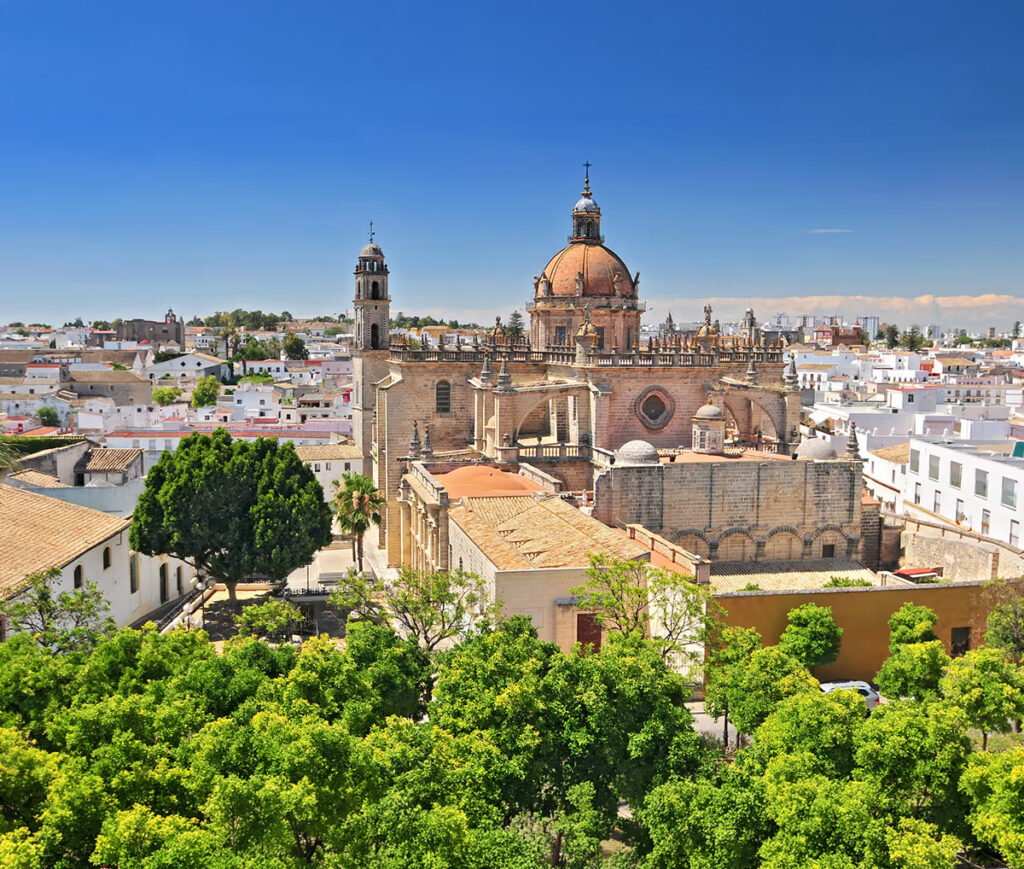
Jerez is internationally renowned for its sherry wines, its heritage as the birthplace of the Carthusian horse, a distinguished lineage of the Pure Spanish Horse, and its status as one of the world's leading centres of flamenco. These three outstanding attractions alone make the city well worth a visit. Yet Jerez has so much more to offer: a remarkable wealth of cultural and architectural heritage, together with a wide range of unique and unforgettable experiences. Discover the city's magnificent historic treasures, from its Cathedral and Alcázar to its countless churches of great artistic value and elegant palatial residences. Throughout the year, Jerez also comes alive with a vibrant calendar of festivals and celebrations, including the Jerez Flamenco Festival, Holy Week, the Horse Fair, the Grape Harvest Festival and the Christmas festivities. Each offers a compelling reason to explore the city and experience its distinctive character. Jerez also enjoys an exceptional location, just 10 kilometres away from the sea and 50 kilometres away from the mountains, making it an ideal base for exploring a remarkable variety of landscapes and attractions. From the unique White Villages Route to the stunning beaches of the "Costa de la Luz", countless experiences await within easy reach, making Jerez a truly complete destination.
Statistical and geographical data

Geographical location

Andalusia, southern Spain. 10 kilometres from the Atlantic coast and 80 kilometres from Seville.

Municipal area

1,189.22 square kilometres. The second-largest municipality in Andalusia and the sixth-largest in Spain by area.

Altitude above sea level

45 metres

Population

215,025 inhabitants. The fifth-largest city in Andalusia and the 27th-largest in Spain by population

Climate

More than 300 days of sunshine a year. Average annual temperature: 17.7°C.

A Brief History of Jerez

12 Milestones in the City's History

1

The earliest documented human settlement in Jerez dates back to the 4th and 3rd millennia BC. This was the site of "Asta Regia", an important settlement that flourished through the Tartessian, Roman, Visigothic and Islamic periods.

2

The origins of the present-day city, however, date back to the Middle Ages, specifically to the late 9th or early 10th century.

3

During the period of Al-Andalus, Jerez was known as "Sharish Saduna" or "Sherish". The city experienced significant growth during these centuries, particularly under Almoravid and Almohad rule.

4

During the 12th and 13th centuries, the medina, city walls, city fortress ("Alcázar") and much of the city's urban layout took shape.

5

On 9 October 1264, King Alfonso X reconquered Jerez and its surroundings and definitively incorporated Jerez into the Crown of Castile. The former medina was repopulated and reorganised into six Christian parishes, although much of its original urban structure was preserved.

6

Its proximity to the Nasrid Kingdom of Granada made Jerez an important military stronghold on the frontier.

7

In 1380, King John I officially granted the city the name Jerez de la Frontera (Jerez of the Frontier). As the frontier shifted eastwards, greater security encouraged the development of agriculture, livestock farming and trade.

8

During the 15th century, Jerez became one of the most prosperous cities in Andalusia. Its agricultural products, particularly wine, were exported first to Europe and subsequently to the Americas.

9

Between the 15th and 17th centuries, numerous convents, churches, palaces and other buildings were constructed, shaping the city's rich architectural heritage.

10

Following a period of economic decline in the 17th century, the 18th century ushered in a new era of expansion, with wine production driving economic growth. Foreign merchants and investment, particularly from Britain, strengthened the international character of the sherry trade.

11

In the 19th century, the booming sherry industry led to a dramatic increase in exports and the emergence of major wine companies and magnificent "bodegas", vast, cathedral-like sherry wineries.

12

During the 20th century, Jerez further established its reputation as a centre of flamenco and equestrian culture. This heritage is embodied by the historic neighbourhoods of Santiago and San Miguel, renowned for their flamenco traditions, and the Royal Andalusian School of Equestrian Art, founded in 1973. Today, Jerez brings together its Andalusian-Islamic, Castilian, winemaking, flamenco and equestrian heritage in a distinctive cultural identity all its own.

http://callejero.jerez.es

City map