MAUNDY THURSDAY
| Ancient and Hospitaller Brotherhood of the Apostle Saint Bartholomew and Confraternity of Penitents of Our Lady of the Greatest Sorrow in the Ecce Homo Mystery. |
Historical Background
The brotherhood traces its origins to 6 April 1488, when members of the shoemakers’, tanners’ and leatherworkers’ guilds founded the Brotherhood of Saint Bartholomew to honour their patron saint and provide support for a hospital. Its rules were formally approved in 1503. The brotherhood subsequently underwent various changes of location and organisation while preserving one of the oldest religious traditions in Jerez.
These developments reflect a gradual process of consolidation in which parish life, religious worship and the brotherhood’s public presence have reinforced one another. Its current canonical seat is the Church of San Dionisio, at Plaza de la Asunción, 11403 Jerez de la Frontera (Cádiz), which remains the focal point of its religious services and devotional activities.
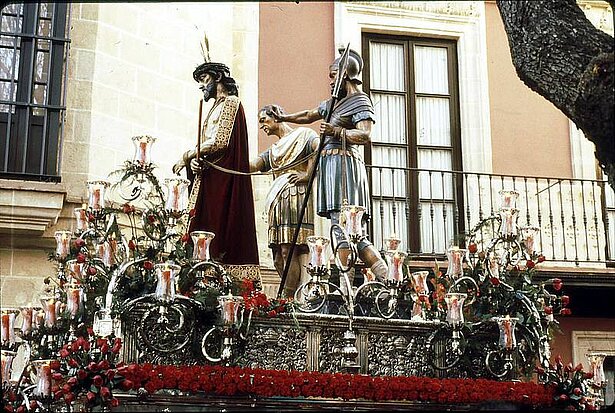
The brotherhood makes its annual penitential procession on Maundy Thursday, as part of the Holy Week celebrations in Jerez. Its history also highlights the importance of its principal sacred images and the successive conservation and restoration efforts that have helped preserve its distinctive identity. The history of the brotherhood can therefore be understood as a combination of religious devotion, institutional continuity and adaptation to the changing circumstances of each period.
Sacred Images and Patron Saints
The Señor del Ecce Homo (Our Lord Ecce Homo) was created by Jácome Vaccaro in 1757. The brotherhood’s principal Marian image is Nuestra Señora del Mayor Dolor (Our Lady of the Greatest Sorrow). The brotherhood also preserves its historic devotion to Saint Bartholomew, reflecting its origins among the craft guilds and its longstanding hospitaller tradition.
Its full official name is “Primitiva y Hospitalaria Hermandad del Apóstol Señor San Bartolomé y Cofradía de Nazarenos de Nuestra Señora del Mayor Dolor en el Paso del Ecce Homo”. This title brings together the different devotions that form the basis of the brotherhood’s religious life and reflects the particular role each plays within its spiritual identity.
The images of Christ and the Virgin Mary traditionally form the focus of contemplation on the Passion and the mysteries of Christ, while the brotherhood’s other sacred dedications complement its spiritual heritage. The artists responsible for these sculptures, their dates of creation, historical attributions and subsequent restorations help place them within Jerez’s rich tradition of religious processional sculpture and contribute to their distinctive artistic character. The continued veneration of these sacred images preserves the brotherhood’s collective memory and provides a lasting focus of devotion for its members and devotees throughout the year
General information
Home Church: Church of San Dionisio, at Plaza de la Asunción, 11403 Jerez de la Frontera (Cádiz)
Pictures / more info (Spanish)